Sep 17, 2025
The iPad Paradox: High-Res Screens, Low-Res Imaginations
When you show them the dragon, they stop imagining it. Why audio storytelling triggers a neural fireworks display that video can never match.
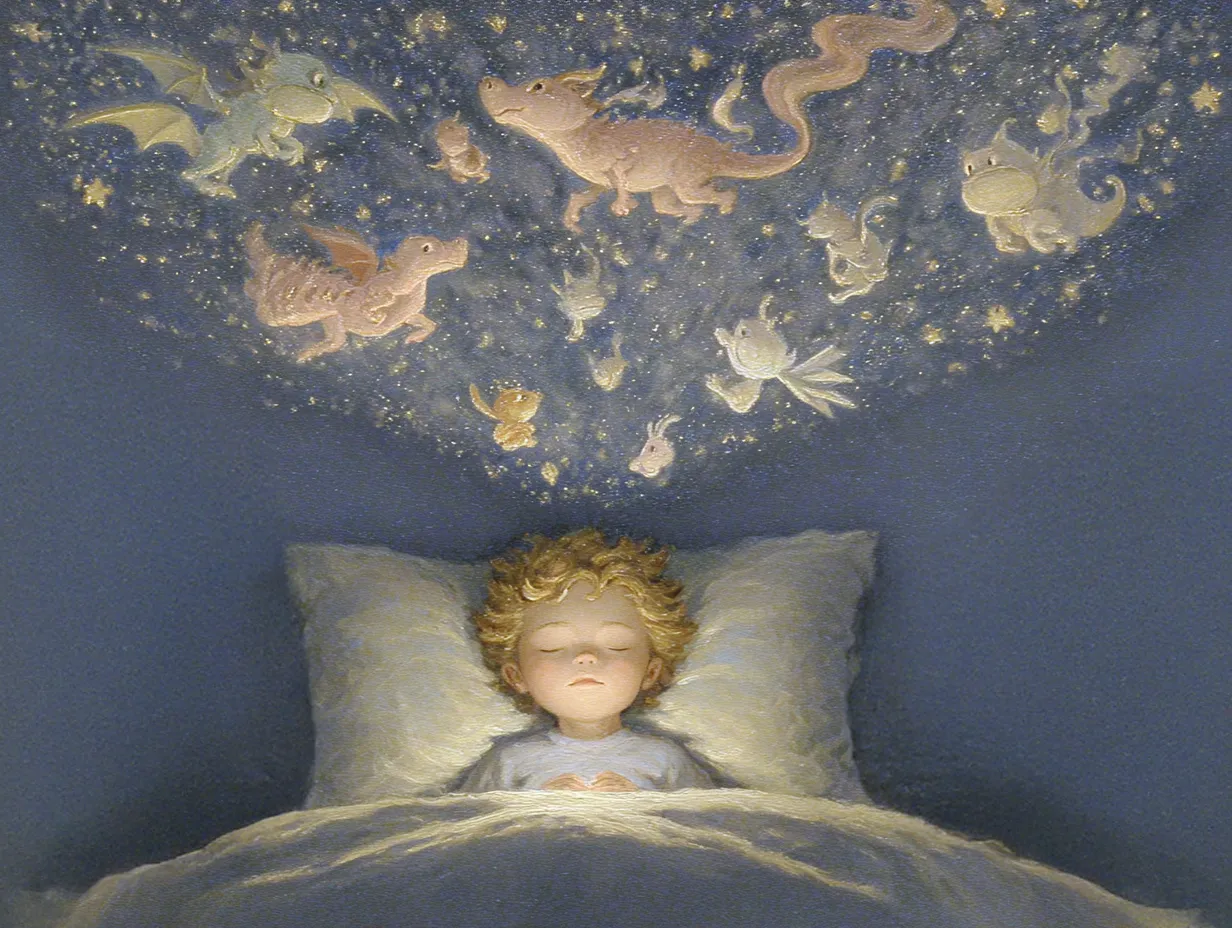
There is a quiet magic that happens in the dark. It’s the moment when the room settles into a soft glow, the world slows down, and the stories begin.
Whether you are reading aloud or listening together, your child is doing something remarkable: they are turning on the projector of their own internal cinema. They are bringing the story to life in their own way.
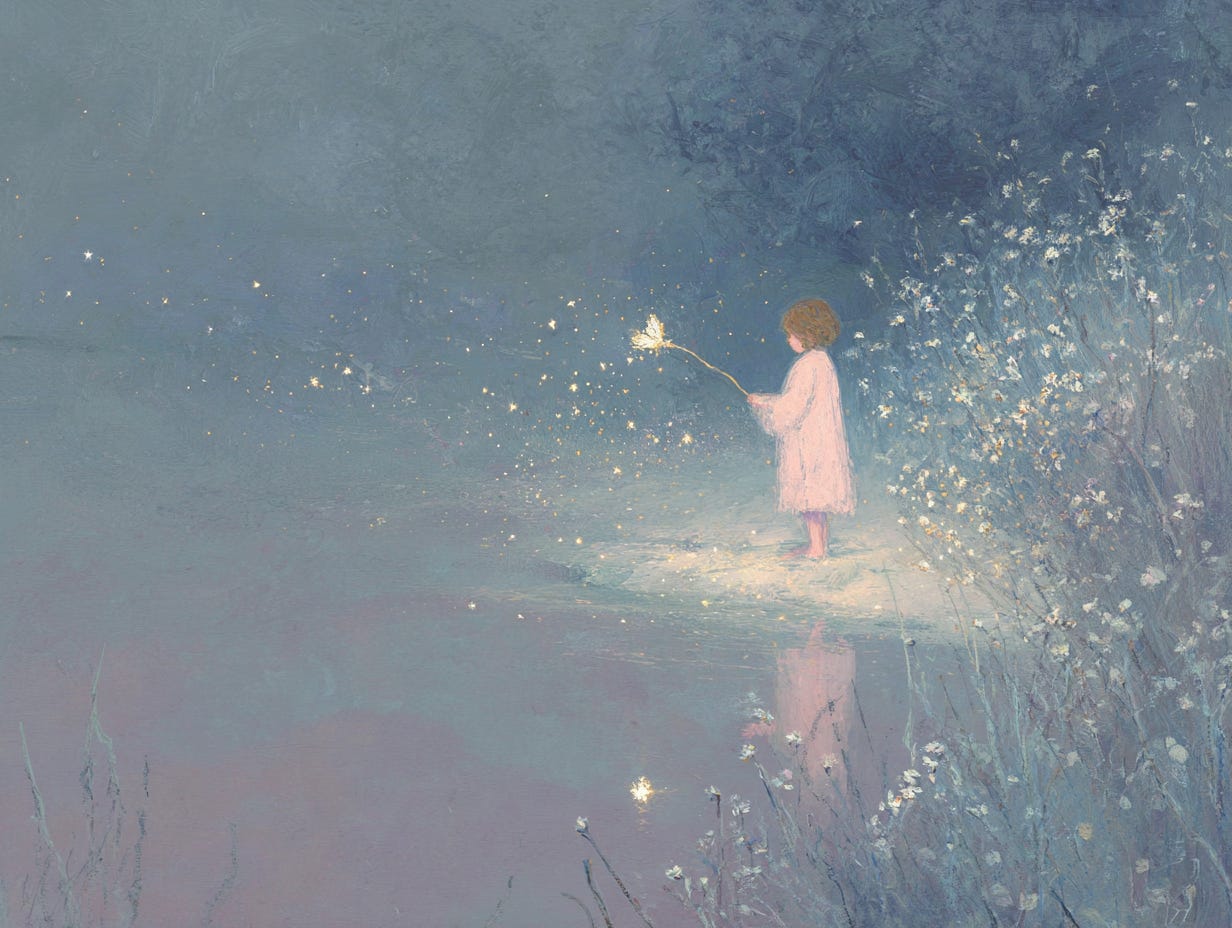
In this inner cinema, the words you speak drift straight into their subconscious. Unlike a movie screen that hands them a ready-made image, storytelling invites them to be the artist themselves. They dress the characters. They choose settings from their own inner library of faces, places, and random memories.
Every child paints their own unique, living version of the scene.
Cultivating a Creative Mind
We often think of imagination as a static trait, but it is actually a skill that thrives when practiced.
When children primarily consume digital media, the active habit of creating their own mental imagery can start to lose its momentum. If a screen provides every detail—from the giant, fuzzy ears of a forest friend to the funny wiggle of a hero’s walk—the child’s brain is simply not required to “image the invisible.”
This is what researchers call “mental representation.” Scientific studies, such as those from the Cincinnati Children’s Hospital, show that when children listen to stories without the shortcut of a screen, the visual processing centers of their brain fire up.

They are quite literally planting seeds of creativity. They are building the neural highways they will later use for complex problem-solving and abstract thought. Without these moments of pure storytelling, the terrain of their imagination can become dormant, leaving their creative power locked away.
A Haven for the Nervous System
But the cinema behind their eyes is not just about cognitive growth; it’s about emotional safety. Listening is in our bones. It’s what humans have done for millennia, huddling around fires to make sense of the world.
When a story is shaped around a child’s real life—their playground dramas, curious new discoveries, or the way they handle all the small and big feelings that are part of growing up—it creates a mental playground.
This is where Theory of Mind (the ability to understand perspectives) comes in. By moving through these scenarios via a character—perhaps a slightly anxious cloud named Boo or a brave rabbit with the child’s own name—children learn to observe their own feelings from a distance.
All the while, a deeper shift is happening within their nervous system. The steady rhythm of a story helps their heart rate align with yours, lowering cortisol and signaling to the body that the energy of the day is over. The tranquility of the night has begun.
From Dreams to Daybreak
The real beauty of the inner cinema is that it doesn’t close its doors when the story ends.

Research into narrative recall suggests that as children drift off, their minds continue to process the adventures they’ve just heard. They often weave those themes into their dreams.
This is a form of emotional rehearsal. By including a small lesson or a moment of bravery into a narrative, you provide them with a mental reference point for the next day. The rabbit who finds his courage in the forest becomes a quiet reminder of their own strength when they face their own hurdles tomorrow, like handling the ups and downs of the schoolyard.
By taking the small details of their daily life and putting them into a story, you meet your child exactly where they are. This canvas of familiar names, feelings, and favorite things becomes the fuel for their imagination. It helps them build a world that is entirely their own.
Tonight, when they ask for “one more,” you are offering them a sense of safety that lets their mind wander freely. Whether you tell the story yourself or listen side-by-side to a soft narration, you are providing more than just entertainment. You are creating gentle anchors that help them move through their world with more confidence and ease.
Keep the Cinema Open
We know that by 7 PM, your own creative battery is often running on empty. You want to give them the magic of a story, but you don’t always have the energy to invent it from scratch.
You don’t have to do it alone.
At Counting Sheep Club, we create personalized, screen-free audio tales designed to help them turn on that internal projector—while you just lie there and listen with them.
Hutton, J. S., Horowitz-Kraus, T., Mendelsohn, A. L., DeWitt, T., & Holland, S. K. (2015). Home reading environment and brain activation in preschool-aged children listening to stories. Pediatrics, 136(3), 466–478.
https://doi.org/10.1542/peds.2015-0359
Schredl, M. (2003). Continuity between waking and dreaming: A theoretical model of secondary dreaming.
Perceptual and Motor Skills, 96(3), 985–1009. https://doi.org/10.2466/pms.2003.96.3.985
Wellman, H. M., & Liu, D. (2004). Scaling of theory-of-mind tasks. Child Development,